
Here’s what we did on Pentecost in our Cafe Church session
Mark Taylor – Minister
Call to Worship
The Spirit descends like a dove,
bringing peace to unite the world
in a just and caring community.
The Spirit comes like a breath,
bringing life to renew the people of God.
The Spirit spreads like fire,
bringing energy for witnessing to the love of God.
Spirit of the living God,
come to us and transform our lives by your power
The Lord’s Prayer
Hymn 1 – Come Down O Love Divine
So today the first thing I’d like to do is to thank Irum for her service last week because if she hadn’t done that I could easily have forgotten it was Pentecost – or Whitsuntide as we used to call it.
I’ve done it before!
I’ve got a lot of childhood memories of Whitsuntide. In the town where Deborah and I grew up – Sutton-in-Ashfield over in the west of Nottinghamshire Whit Sunday was one of the really big days in the calendar – both of the town’s churches and of the town as a whole
What used to happen – for all the years of my childhood at least – was that all the town’s churches would process around the town on the ‘Whit Walk.’ The churches would have banners and hundreds of people would be in the procession which ended up in the town’s market place. You’d always have a new set of clothes. And the streets were lined with people – many more people watching than in the parade – to witness the event. It seemed like the whole town was out to watch.
There’d be a service in the market place and all the children would traditionally be given a fruit bun as a reward for attendance.
Things were simpler then.
I remember one year the weather must have been like it is today – baking hot. The market place had been recently re-tarmacked and the tarmac melted and stuck to our shoes. Which didn’t do a lot of good to my brand new white soled sandals!
I just want to show you a picture of one of the walks.
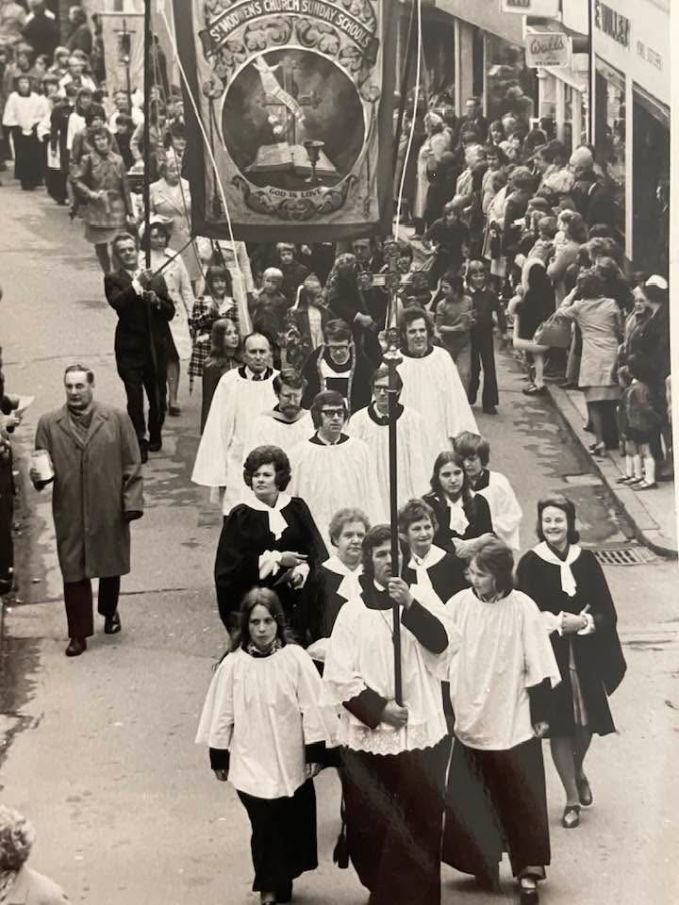
I can’t tell you what year this was – probably early to mid 1970s – but this was the group from my church at the time – St Modwen’s Church of England. These were all people who played a big part in my life at that time – though I’m not in the picture myself. I sang with the choir and can name all the choir people in the picture. The man holding the pole of the banner is my godfather. And that lady just behind him is my mum who was in charge of the Sunday School.
Thank you for indulging me in some happy memories.
So let’s get onto some proper content.
But before we do that there’s a song to listen to –
Hymn 2 – I Gotta Move when the Spirit Say Move
As Irum reminded us last week the events of the first Pentecost happened 10 days after Luke reported Jesus’ Ascension into heaven – and 50 days after the first Easter. That’s where Pentecost gets its name from – it means fiftieth day.
Pentecost was a Jewish Festival before it was a Christian one. Called Shavuaot. Shavuot was also 50 days after another event – in the Jewish case 50 days after the feast of the Passover. The Passover of course commemorates the day when the tenth plague of Egypt caused the death of all the first-born sons of the Egyptians and led to the release of the Israelites. Easter was the time when God’s own son was killed. I wonder if that might explain the timing of the first Christian Pentecost – to draw a parallel between the two events – the literal release from captivity of the Israelite slaves and the metaphorical release from captivity of humanity that Jesus brought about.
I think I’ve mentioned before that I’m not a believer in the bodily ascension of Jesus into heaven – it makes no sense to me. But the gospel writers were dealing with unprecedented events here.
They’d seen their leader brutally killed – but then had witnessed his presence among them again after Easter Sunday. But then the appearances stopped – why? They needed an explanation. In the understanding of the universe they then had heaven was located physically above the earth – so it made sense to have Jesus rise up into the sky to be re-united with his father.
Whatever happened the experience the disciples had of the risen Jesus changed after 40 days. And then they did as Jesus asked – stay in the city until you have been clothed with power from on high.
We’re going to come onto the events that happened 10 days later in a while.
But before that I want you to have a look at something for me. I’ve printed out some Bible passages that relate to the Holy Spirit. There are 10 in all.
Your task – should you choose to accept it – is to read all the 10 passages and to categorise them into ones that are from the Old Testament and ones that are from the New Testament. Here they are:
1 In the beginning God created the heavens and the earth.Now the earth was formless and empty, darkness was over the surface of the deep, and the Spirit of God was hovering over the waters.
2 Then the Lord said to Moses, ‘See I have chosen Bezalel son of Uri, the son of Hur, of the tribe of Judah, and I have filled him with the Spirit of God, with wisdom, with understanding, with knowledge and with all kinds of skills
3 Now all the Midianites, Amalekites and other eastern peoples joined forces and crossed over the Jordan and camped in the Valley of Jezreel. Then the Spirit of the Lord came on Gideon, and he blew a trumpet, summoning the Abiezrites to follow him.
4 Then the Lord said, ‘Rise and anoint him; this is the one.’
So Samuel took the horn of oil and anointed him in the presence of his brothers, and from that day on the Spirit of the Lord came powerfully upon David.
5 These are the last words of David:
‘The inspired utterance of David son of Jesse,
the utterance of the man exalted by the Most High,
the man anointed by the God of Jacob,
the hero of Israel’s songs:
‘The Spirit of the Lord spoke through me;
his word was on my tongue
6 Create in me a pure heart, O God,
and renew a steadfast spirit within me.
Do not cast me from your presence
or take your Holy Spirit from me.
Restore to me the joy of your salvation
and grant me a willing spirit, to sustain me.
7 Yet they rebelled
and grieved his Holy Spirit.
So he turned and became their enemy
and he himself fought against them.
Then his people recalled the days of old,
the days of Moses and his people –
where is he who brought them through the sea,
with the shepherd of his flock?
Where is he who set
his Holy Spirit among them
8 He said to me, ‘Son of man, stand up on your feet and I will speak to you.’ As he spoke, the Spirit came into me and raised me to my feet, and I heard him speaking to me.
9 I will give you a new heart and put a new spirit in you; I will remove from you your heart of stone and give you a heart of flesh. And I will put my Spirit in you and move you to follow my decrees and be careful to keep my laws.
10 ‘And afterwards,
I will pour out my Spirit on all people.
Your sons and daughters will prophesy,
your old men will dream dreams,
your young men will see visions.
Even on my servants, both men and women,
I will pour out my Spirit in those days.
Just pause to consider your answers before reading on
Here’s where you can find the texts
Genesis 1:1-2
Exodus 31:1-3
Judges 6:33-34
1 Samuel 16:13
2 Samuel 23:1-2
Psalm 51:10-12
Isaiah 63:10-11
Ezekiel 2:2
Ezekiel 36:26-27
Joel 2:28
So it was a bit of a trick question. All 10 of the passages that referred to the Holy Spirit were from the Old Testament – the Hebrew Bible.
Let’s have another hymn now.
Hymn 3 This one is ‘There’s a Spirit in the air’
Finally – lets get down to the story Luke recorded of that first Pentecost in Acts Chapter 2:1-13.
The Coming of the Holy Spirit
2 When the day of Pentecost came, all the believers were gathered together in one place. Suddenly there was a noise from the sky which sounded like a strong wind blowing, and it filled the whole house where they were sitting. Then they saw what looked like tongues of fire which spread out and touched each person there. They were all filled with the Holy Spirit and began to talk in other languages, as the Spirit enabled them to speak.
There were Jews living in Jerusalem, religious people who had come from every country in the world. When they heard this noise, a large crowd gathered. They were all excited, because all of them heard the believers talking in their own languages. In amazement and wonder they exclaimed, “These people who are talking like this are Galileans! How is it, then, that all of us hear them speaking in our own native languages? We are from Parthia, Media, and Elam; from Mesopotamia, Judea, and Cappadocia; from Pontus and Asia, from Phrygia and Pamphylia, from Egypt and the regions of Libya near Cyrene. Some of us are from Rome, both Jews and Gentiles converted to Judaism, and some of us are from Crete and Arabia—yet all of us hear them speaking in our own languages about the great things that God has done!” Amazed and confused, they kept asking each other, “What does this mean?”
Now clearly no one alive today was a witness to these events. The only account we have is that of Luke in Acts.
Was Luke there as an eye-witness? – no one knows.
So what are we to make of this account of extraordinary happening in Jerusalem in AD 33ish.
If you ask anyone – well anyone with a clue what you’re talking about – what they know about the story of the first Pentecost the first things they are likely to mention are the strong wind blowing and the tongues of flame.
If we had been there is that what we would have experienced? I don’t know. I’m certainly not saying that these events could not have happened literally as Luke describes.
But what I would say is that it doesn’t matter whether they did or not. Because to me the much more powerful thing is the metaphoric meaning of the wind and the flames and the impact of that day on the disciples.
So for your second task of the morning I want you to think about those two words – wind and flame – and think about how they could be interpreted metaphorically. That is symbolically rather than literally
What is it about those two words that makes them appropriate for the transforming nature of the events on that day. Can you think of any phrases using wind or fire that might be relevant to what happened.
Just five minutes and then some feedback
Here are some I thought of
Wind metaphors
• The Winds of Change
–A powerful force that brings significant transformation
• A Fresh Wind
– Something new and welcome that replaces what was stale or stagnant.
•The Wind Beneath My Wings
–A person or force that silently supports and lifts someone up, enabling them to succeed.
•Throwing Caution to the Wind
–Letting go of fear and worry to act boldly
Fire metaphors
• On Fire
–Performing exceptionally well, full of energy, and seemingly unstoppable
• Spreading Like Wildfire
– Moving or expanding rapidly and uncontrollably, especially through a group of people
• Keeping the Flame Alive
–Maintaining a passion, tradition, relationship, or commitment over time, even when it takes effort.
•A Fire in the Belly
–A deep, burning motivation and hunger to achieve something meaningful
Some closing words from me to sum things up
First of all – let’s think about what we’ve just been doing.
I think it’s often the case that you get much more from reading the Bible if you don’t just read things as simple stories.
It’s fine just to read the passage in Acts 2 and think – that’s how the Holy Spirit first came. But if we do that what do we get from it if we’ve heard the same story for the last 20, 40, 60 or more years?
To me the metaphorical meaning behind the narrative is much more interesting and tells us much more.
Luke is a skilled writer and I’m sure that when he used the images of wind and fire he intended us to think about them in the way we just have. To allow those words to conjure up thoughts like the ones we just mentioned.
Because that was the effect on the Disciples
Let’s look again
The Holy spirit certainly was
A powerful force that brings significant transformation
It was
Something new and welcome that replaces what was stale or stagnant.
It did
silently support and lift the disciples up, enabling them to succeed.
It did allow Peter in particular to
let go of fear and worry to act boldly. The next passage in the story is of Peter giving a lengthy and passionate sermon – something he had shown no signs of being able to do before.
Peter was On Fire
Performing exceptionally well, full of energy, and seemingly unstoppable
And his message and that of the others did Spread Like Wildfire
3000 people were baptised that very day we are told
And as the following years showed the disciples did
Maintain their passion, their commitment over time, even when it took effort and indeed sacrifice.
And it was all brought about by
A deep, burning motivation and hunger to achieve something meaningful
Let’s go back now to the first exercise you did. Because that shows us something important too and it’s this:
the Holy Spirit didn’t put in its first ever appearance at Pentecost.
Looking at the verses we read the Holy Spirit has been there all the time. Right from the first day of Creation – from the beginning of the universe.
The Holy Spirit was there for the Jews many, many years before the incarnation of Jesus.
And this means – surely – that the Holy Spirit is there for absolutely everyone. Anyone can access the empowering presence of the Holy Spirit. That Holy Spirit is within us all – our own personal experience of God in us – every day of our lives.
Like the disciples we are called to live our lives in that Spirit, in the power of the wind, with the fire in our hearts, as we live out our faith in Jesus.
Let us pray
Lord as we remember that first Christian Pentecost help us to recognise that your spirit is within us all here today. Your spirit is our internal knowledge and experience of your presence. We know you intimately because of your spirit within us. We don’t need to search for you in heaven, we can find you in our hearts every day, all the time.
Help us, in that knowledge to live our lives as the disciples did, witnessing to your nature as revealed to us by Jesus, in everything we do and everything we say, so that by our witness others will come to recognise that the way of life Jesus taught is able to transform our lives and the lives of everyone on earth.
Amen
Our final hymn
Hymn 4 – Spirit of the Living God
Let’s close with saying the grace to one another
The grace of our Lord Jesus Christ,
and the love of God,
and the fellowship of the Holy Spirit
be with us all now
and for evermore.
Amen.





Leave a Reply