
Just to prove I’ve been doing something here’s part of my introduction.
I write these words as I sit in Launde Abbey Retreat Centre in Leicestershire, England, where I have come to attempt to put together a document that outlines my current thinking about my faith, my theology.
I was raised in the Church of England, joined the United Reformed Church and finally a Congregational church. I have never consciously been without faith, but for my first 50 years it wasn’t something that I critically examined and explored. I was a Christian, but my Christianity was an unformed thing.
This began to change when, following a visit to Zambia I returned convinced I wanted to preach on social justice, but very aware that I had no idea how to do it. I enrolled on the Congregational Federation’s ‘Integrated Training Course ‘ and 10 years later found myself with a degree in Practical Theology. From the beginning this excellent course excited me, challenged me and opened many doors into areas of my faith I had never given serious thought to.
In late 2020 I unexpectedly found myself being asked to become my church’s (part time) minister. I never wanted to be a minister. I know I’m not very good at some parts of the job. But it has meant that I have of necessity continued to think about my faith as I led worship week-by-week.
My vow to myself has always been that I would never preach something that I didn’t hold to be true. Neither do I require my congregation has to accept what I say – I’m not presumptuous enough to suggest I know all the answers. I’ve found, as year follows year, that my faith has changed radically and become clearer to me.
My purposes in writing this booklet are two-fold:
- To clarify and systematise what I think
- To offer others my take on what it means to be a Christian in the 21st century
It is this latter point that is my main driver.
I am convinced that the quest to understand humanity’s place in the universe is widespread. I am certain that Christianity has many worthwhile insights to offer on this question. I strongly suspect, however, that the way people outside the churches perceive the church, in particular what they think you have to believe to be a Christian, is off putting and that this is an obstacle to them listening to what the church has to say.
My aim is to point out that not all Christians are the same and that many of the things that people may see as obstacles to engaging with the Christian faith need not be.
As a taster:
- You don’t have to believe a literal 6-day creation and can accept the Big-Bang;
- You don’t have to believe that all animals were created at once and can accept the Theory of Evolution;
- You don’t have to believe that God hates people in gay relationships.
I know this because I’m a Christian and I don’t believe any of these things.


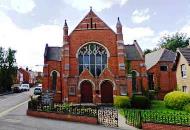


 Newark Congregational Church
Leave a reply to Richard Gascoyne Cancel reply