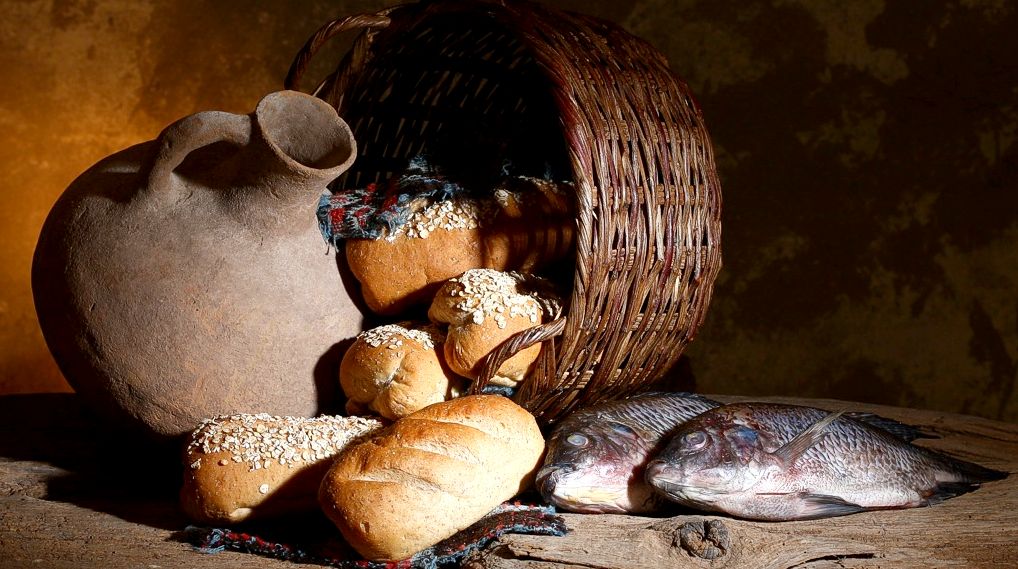
This is my sermon from sunday.
What do you think?
Mark
Luke 9:10-17
The apostles came back and told Jesus everything they had done. He took them with him, and they went off by themselves to a town called Bethsaida. When the crowds heard about it, they followed him. He welcomed them, spoke to them about the Kingdom of God, and healed those who needed it.
When the sun was beginning to set, the twelve disciples came to him and said, “Send the people away so that they can go to the villages and farms round here and find food and lodging, because this is a lonely place.”
But Jesus said to them, “You yourselves give them something to eat.”
They answered, “All we have are five loaves and two fish. Do you want us to go and buy food for this whole crowd?” (There were about 5,000 men there.)
Jesus said to his disciples, “Make the people sit down in groups of about fifty each.”
After the disciples had done so, Jesus took the five loaves and two fish, looked up to heaven, thanked God for them, broke them, and gave them to the disciples to distribute to the people. They all ate and had enough, and the disciples took up twelve baskets of what was left over.
Here we have a story that is repeated in all four of the Gospels. I always think that when this is the case it means that the story must be particularly significant. –The gospel writers, each writing about Jesus in their own way and for different audiences all consider it important enough that it has to be included.
We’re going to have a think about what the story is all about. But first is there something missing from the story as we heard it read this morning?
The disciples said in Luke’s account “All we have are five loaves and two fish. Do you want us to go and buy food for this whole crowd?” Matthew’s version is much the same. As is Mark’s. But in John’s gospel it says: “There is a boy here who has five loaves of barley bread and two fish. But they will certainly not be enough for all these people.”
Did you spot that the boy wasn’t mentioned. I bet if I’d asked any of you to tell the story from memory in your own words you’d all have included the boy. We might mention that detail again later.
So what are we to make of this extraordinary story?
On the face of it it’s the story of a miracle – Jesus making five loaves and two fish into a meal for 5000 people.
Now here’s a thing – that’s not the number the story says. The story says there were 5000 men. We know that Jesus didn’t just attract men to listen to him, but women and children too – but it seems nobody thought they were worth counting! There would have been far more than 5000 people there in total. What would be a good guess – maybe double that number – shall we say 10,000 altogether?
And what was this town of Bethsaida, where the story takes place, what was it like? The story says it was a lonely place – sources I’ve seen say it was more like a village than a town. So where were all these people from? There surely can’t have been 10,000 people living in this fishing village? In fact we know they weren’t from Bethsaida itself – the disciples ask Jesus to send the people way to surrounding settlements to find food and lodgings. They’ve travelled a fair distance to get here to listen to Jesus and now it’s evening – the sun is about to set – they aren’t going to get back home in time to sleep.
Now these people lived a long time ago – but they weren’t stupid. Can I ask you a question? If you were going to make a journey to a place quite a way from home and you knew you weren’t likely to be back home for a while what would you do?
I’d be inclined to think that you’d perhaps plan ahead a bit and take something with you. Yesterday we didn’t just leave our homes to do a 7 hour walk without taking a picnic with us. We didn’t wander out without thinking. We didn’t assume that if we took nothing to eat and drink ‘something would just turn up.’
And again – there’s evidence in John’s version of the story that this is what at least one person had done. A boy had taken 5 loaves and 2 fishes with him for his picnic – it sounds to me that he’d probably taken more than he needed just for himself. Would he have been the only one? The only person among 5,000 – 10,000 perhaps to have had the foresight to plan ahead?
Now it’s clear to me that not only did Jesus say extraordinary things – things of great wisdom and insight that taught us about how to live our lives in accordance with God’s wishes – but that he did extraordinary things too. He had a reputation didn’t he for healing people? It was one of the reasons that brought these vast crowds to see him. And this feeding of the 5000 might have been one of those extraordinary things – it might have been a bona fide miracle. But I think there’s a chance that it wasn’t – but instead it was something that was able to teach us something much more profound.
Because after all is said and done what does a miracle signify? It says – the person that did this amazing thing must be an amazing person. And that’s true. But we know that about Jesus anyway – Jesus doesn’t need to keep pulling metaphorical rabbits out of his metaphorical hat for us to know he’s amazing. Of course it’s the case that we need to realise how special Jesus is – because what we think is that he is God incarnate – God in human form and that what he has come to reveal to us is the truth about what God is like.
Now anybody can stand in front of a crowd and tell them what to do – can tell them that it’s what God wants them to do. Over the centuries many people have done that. But if we’re to believe them they must convince us that what they are saying is trustworthy – that when they say ‘God says this to you’ we can have confidence that it’s true.
But what they don’t need to do is to go on and on proving that they’re special. Once they’ve established their credentials they need to spend their time, their valuable time, in Jesus case their very limited time (he only had 3 years) they need to spend their time actually telling us what they have to tell us about God.
And doing another miracle doesn’t teach us anything about what to do with our lives does it? Miracles are outside the normal human experience – what are we supposed to do with the information – God in Jesus can do some amazing stuff.
So let’s bring the little boy back into the story now. John wrote the last of the 4 gospels. That means he had a few more years to think about it. The life of Jesus needed a lot of thinking about. If you read John’s gospel it’s not long before you realise that he’s thinking very deeply about this life he’s trying to explain. It’s very different to say Mark’s gospel (the first one) which goes straight into the story of Jesus’ adult life. Matthew and Luke came next – and their Gospels start with the stories of Jesus birth – things that would never have been known by those who saw the adult Jesus – Mark doesn’t mention them. But read the start of John’s gospel – we won’t do it now but you’ve all heard it many times before at Christmas – the start of John’s Gospel is trying to say just how very special Jesus was. You might want to look at the start of all 4 gospels when you get home to see what I mean.
But going back to today’s story – only John put the little boy in there. Why?
Here’s a thought. Perhaps it’s because John, having thought about things for a lot longer that the other 3, had recognised that this story, whether or not it involved a miracle, wasn’t about the miracle at all.
Put the little boy into the story and what is it about?
- It’s about selfless giving. The boy was OK – he at least had thought ahead and brought his picnic. But he didn’t give the disciples 3 loaves and 1 fish – he gave them everything he’s brought with him – all five loaves and both fish. He left himself with nothing so that others could have something;
- It’s about people coming together to sort something out. The boy knew, of course he knew, that his little meal wasn’t going to be enough. But perhaps he also knew or hoped that if he did his little something others might do the same, and that if enough people did the same maybe there would be an impact, maybe a problem that looked beyond help could be sorted out;
- It’s about there being sufficient (in fact more than enough) for everyone. We all know this to be true don’t we? There are people starving in this world – still to our shame. But this story is saying there’s plenty for everyone if we share. It means some of us giving away what we have – we can’t hold on to everything we happen to have and expect everyone to be fed. Most of all we can’t hold on to everything we have and then pray to God to solve world hunger by some mega-miracle. What hypocrisy that would be – but how often in so many instances is that what we do. Think about the gun laws in America. Every time – every time – there’s another mass shooting we hear the same old trite formula. ‘Our prayers are with the families of the victims’. Very nice I’m sure. But if we are serious in our faith we need to solve the problems. It’s within our power. Let’s do something about it. That’s what God wants
I think these are the lessons we can get from this story of feeding the 5000. It may have been a miracle. But I think we can learn much more by approaching the story of what we can do for ourselves, through selflessness, through coming together, and by recognising that it’s our actions, not our prayers, that can make this a better world and can bring closer God’s Kingdom.
Amen



 Newark Congregational Church
Leave a comment