
Here’s what I had to say on Sunday.
It was quite well received so I thought I’d share it.
Mark
Call to Worship
In a world filled with violence and war,
we gather together to celebrate the promise of peace.
In a world filled with tyranny and oppression,
we gather together to celebrate the promise of justice for all.
In a world filled with hunger and greed,
we gather together to celebrate the promise of plenty for all.
Our hope is in the name of the Almighty God,
the Creator, Redeemer, and Sustainer of heaven and earth.
Two minutes silence
Now I’m not normally one for tradition in church services. But one tradition we have long upheld here, and which I am proud to continue, is to read a list of people from this church that died in the First and Second World Wars. I think it’s a good way of reminding us that remembering the fallen isn’t an abstract thing but that every one of them was an individual person.
<READ LIST>
Another tradition that will continue as long as I lead worship on Remembrance Sunday is for us to sing what I think is the finest remembrance hymn
Our first hymn this morning is O Valiant Hearts
Prayer
Gracious God, remember your holy promise, and look with love on all your people, living and departed.
On this day we especially ask that you would hold forever all who have suffered during war, those who returned scarred by warfare, those who waited anxiously at home, and those who returned wounded, and disillusioned; those who mourned, and those communities that were diminished and suffered loss.
Remember too those who acted with kindly compassion, those who bravely risked their own lives for their comrades, and those who in the aftermath of war, worked tirelessly for a more peaceful world.
And as you remember them, remember us, O Lord; grant us peace in our time and a longing for the day when people of every language, race, and nation will be brought into the unity of Christ’s kingdom.
This we ask in the name of the same Jesus Christ our Lord.
Amen.
The Lord’s Prayer
Let’s have our Bible readings now. 2 sections of Matthew chapter 5 from the Sermon on the mount.
The Beatitudes
5 When Jesus saw the crowds, he went up the mountain; and after he sat down, his disciples came to him. 2 Then he began to speak, and taught them, saying:
3 ‘Blessed are the poor in spirit, for theirs is the kingdom of heaven.
4 ‘Blessed are those who mourn, for they will be comforted.
5 ‘Blessed are the meek, for they will inherit the earth.
6 ‘Blessed are those who hunger and thirst for righteousness, for they will be filled.
7 ‘Blessed are the merciful, for they will receive mercy.
8 ‘Blessed are the pure in heart, for they will see God.
9 ‘Blessed are the peacemakers, for they will be called children of God.
10 ‘Blessed are those who are persecuted for righteousness’ sake, for theirs is the kingdom of heaven.
11 ‘Blessed are you when people revile you and persecute you and utter all kinds of evil against you falsely on my account. 12 Rejoice and be glad, for your reward is great in heaven, for in the same way they persecuted the prophets who were before you.
38 ‘You have heard that it was said, “An eye for an eye and a tooth for a tooth.” 39 But I say to you, Do not resist an evildoer. But if anyone strikes you on the right cheek, turn the other also; 40 and if anyone wants to sue you and take your coat, give your cloak as well; 41 and if anyone forces you to go one mile, go also the second mile. 42 Give to everyone who begs from you, and do not refuse anyone who wants to borrow from you.
Talk
As I’m sure I’ve said before leading worship on Remembrance Sunday is always difficult.
There’s a really fine line to tread between the perfectly correct process of Remembrance of those who died and the ever-present risk of tripping over into the glorification of war.
And I think it’s particularly difficult this year.
Just over a month ago Hamas terrorists entered Israel from the Gaza strip. They killed more than 1400 people and took hostage more than 200 others.
Israel has retaliated by bombing and invading Gaza with a declared aim of destroying Hamas.
It is widely believed that so far over 10,000 people in Gaza have been killed as a result of Israeli strikes including thousands of children. Perhaps a million people have become refugees.
Israel expects the war to be lengthy. Casualties will, of course, continue to escalate while ever the war continues.
We are becoming used to seeing images on our televisions every evening showing children who have been injured, children who are crying out for their missing parents, children who have been killed.
Children on both sides have died, other civilians on both sides have died. They have done nothing wrong.
Let’s have a song for reflection now. The Hebrew word shalom has a number of meanings peace, harmony, wholeness, completeness, prosperity, welfare and tranquility.
The lyrics of this song are simple – Shalom my friend The peace of Christ I bring to you. Just sit and listen to the calming repetitive words.
I’d like us now to have a second 2 minutes of silence – this time not to think of those who served in the forces in wars – but to remember the innocent victims of war.
Talk 2
A church service isn’t the appropriate time or place to consider the rights and wrongs of those involved in the current war in Gaza and Israel. There are many heated opinions on both sides. The right of Israel to defend itself and take revenge for the attacks; the extent to which that retaliation should go; the likelihood of the mission in Gaza achieving Israel’s aims; whether there should be a ceasefire – all these things divide opinion.
But perhaps I can offer some thoughts on a few things that might bring people together
First – it’s OK for people to criticise the actions of both sides in the conflict.
To condemn the actions of Hamas in provoking the conflict.
To challenge the ferocity of the Israeli response.
What’s not acceptable is to turn this to hatred of whatever side you are against, to condemn all Jews for the attacks on Gaza, to make Hamas’s action the fault of all Moslems.
People in faith or ethnic groups are not all the same. They don’t all believe in the same things.
I’m certain that I could ask questions of you all in here which would divide opinion starkly in this congregation. (I’m not going to by the way)
But things like:
- Who are you going to vote for in the next election?
- Was creation as described in Genesis?
- Was Jesus’ mother Mary a virgin when she gave birth to him?
would reveal that even among the 20 or so people here this morning we aren’t of the same opinion.
So to suggest that all the billions of people in Islam side with the actions of Hamas, or all the citizens of Israel, let alone all the Jews around the world, agree with the actions of the Israeli government is nonsensical.
Second – Retaliation is understandable, but restraint has a part to play.
There are 2 natural human responses to a physical attack. The first one is to fight back. The second one is to back away. Or run away.
What did Jesus have to say on the subject? Well we heard that a few minutes ago:
You have heard that it was said, “An eye for an eye and a tooth for a tooth.” 39 But I say to you, Do not resist an evildoer. But if anyone strikes you on the right cheek, turn the other also
It’s interesting that for a couple of reasons. This eye for an eye thing that Jesus mentions comes from the Old Testament. Leviticus 24;19-20 says
Anyone who maims another shall suffer the same injury in return:fracture for fracture, eye for eye, tooth for tooth; the injury inflicted is the injury to be suffered.
That’s the Jewish scripture on retaliation. It specifies a punishment – but that punishment is limited. It’s proportionate to – equal to – the injury inflicted. It does say that that if someone inflicts a limited injury on you that you are free to do whatever you want in retaliation or punishment.
Then Jesus goes even further – turn the other cheek. That’s really difficult, it’s particularly difficult for the government of a nation that has suffered a grievous attack like Israel did. The clamour for vengeance in such circumstances can be overwhelming – not to revenge the attack would be seen as weakness. It would be the same if the UK had come under attack.
But the message of both Jewish and Christian teaching is clear – if someone does you harm you haven’t got carte-blanche to do whatever you like in return.
Third – peace isn’t just the absence of war.
One day whether sooner or later, the armed conflict in the region will come to an end.
But that won’t necessarily mean there will be peace. Jesus said – as we’ve heard:
‘Blessed are the peacemakers, for they will be called children of God.
I don’t think that Jesus meant his words about peacemakers to refer solely to bringing an end to a particular conflict. Although that would be a welcome first step. And that of course is the reason why 11 November is remembered. It celebrates the day the dreadful conflict on the Great War came to an end with the Armistice.
But we all know what happened 21 years later. The Armistice led to the end of a fighting and the subsequent Treaty of Versailles formally ended the war but one French military leader predicted with alarming accuracy that the treaty did not represent peace but rather an “armistice for twenty years.” As early as 1923 one German was saying that the Treaty was designed to ruin the German nation. That was Adolf Hitler.
The ‘War to end wars’ didn’t do that. The war in Gaza won’t solve the Middle East problem. Peace needs to be based on justice, on fairness, on mutual recognition and acceptance of another’s point of view.
Time for some more music.
Last year I played a song by Eric Bogle called ‘The Band Played Waltzing Matilda.’
In my opinion that is the best anti-war sing I have ever heard.
The second best anti-war song I have ever heard is the one we are going to hear now – it’s called ‘No Man’s Land’ or ‘The Green Fields of France.’
And it too is by Eric Bogle.
Time for Prayer
Our final hymn today is For the Healing of the Nations by Fred Kaan.
Finally we will close by saying the grace:
May the grace of our Lord Jesus Christ
and the love of God
and the fellowship of the Holy Spirit
be with us all
evermore.
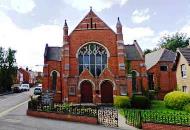



 Newark Congregational Church
Leave a comment